Chia Seeds for Hormonal Balance and Estrogen: The 5-Pathway Guide Nobody Else Wrote
Sarah spent $4,200 in eighteen months trying to fix her hormones.
DUTCH test. Integrative physician. A cabinet full of DIM supplements, vitex, and progesterone cream. Her nutritionist reviewed everything and asked one question: “How much fiber are you eating per day?”
The answer was nine grams. The recommended amount is 25 to 38 grams.
She added two tablespoons of soaked chia seeds to her morning smoothie. Nothing else changed immediately. But eight weeks later, her afternoon energy crashes had largely stopped, her cycle had regularised for the first time in two years, and her follow-up test showed estrogen metabolites moving in the right direction.
Was it just the chia seeds? Almost certainly not. But here is what her story reveals: the connection between chia seeds and hormonal balance is not about phytoestrogens and receptor binding. That is what every competitor article covers. The real story is far more interesting — and far more actionable.
This article covers five distinct pathways through which chia seeds support hormonal balance. Four of them are almost entirely missing from competitor content. One involves gut bacteria that most people have never heard of. Another involves a ratio that determines whether your estrogen is working with you or against you. All five are backed by peer-reviewed research published between 2019 and 2026.
What Does Hormonal Balance Actually Mean — and Why Is Estrogen So Hard to Manage
Here is what nobody tells you about estrogen: the problem is rarely the amount. It is the ratio.
Estrogen and progesterone work as a pair. Estrogen builds. Progesterone balances. When estrogen is high relative to progesterone — regardless of whether estrogen levels themselves are “normal” — you get what clinicians call estrogen dominance. Symptoms include heavy or irregular periods, breast tenderness, bloating, mood swings, weight gain around the hips and thighs, and brain fog.
An estimated 50% of women over 35 experience some degree of estrogen dominance. The causes are multiple: declining progesterone production with age, chronic stress (which depletes progesterone to make cortisol), environmental xenoestrogens from plastics and pesticides, and — most overlooked — impaired estrogen clearance through the gut.
That last cause is where chia seeds become directly relevant. And it is the one that almost no article on this topic explains properly.
Pathway 1: The Estrobolome — The Gut Bacteria That Determine Your Estrogen Levels
This is the mechanism that will change how you think about hormones entirely.
The estrobolome is the collection of gut bacteria specifically responsible for metabolising estrogen. Here is how the process works: your liver conjugates (deactivates) used estrogen and sends it to the digestive tract for excretion via bile. In the gut, bacteria produce an enzyme called beta-glucuronidase. This enzyme can reactivate that conjugated estrogen and return it to circulation via the portal vein — instead of eliminating it in faeces.
A disrupted gut microbiome with high beta-glucuronidase activity means more estrogen getting reabsorbed rather than eliminated. More reabsorption means higher circulating estrogen. More circulating estrogen means a worsening estrogen-to-progesterone ratio — even when your diet is otherwise clean.
Published in the International Journal of Cancer, April 2025: A University of British Columbia review confirmed that estrobolome disruption may promote breast cancer through exactly this mechanism — impaired estrogen conjugation and excessive reactivation of estrogen metabolites. Low-fiber diets were specifically identified as a recognised factor shaping estrobolome function.
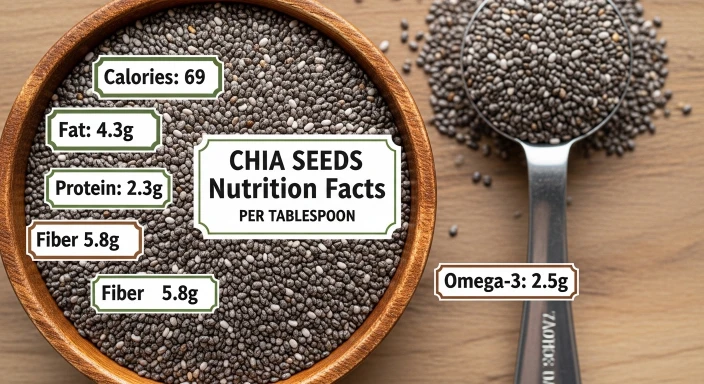
Chia seeds provide 4.9g of prebiotic soluble fibre per tablespoon — one of the highest concentrations in any plant food. This fibre feeds Bifidobacterium, Lactobacillus, and other beneficial bacteria that support healthy beta-glucuronidase regulation. Adequate fibre intake directly supports the estrobolome.
Two tablespoons of chia seeds daily adds approximately 10g of fibre — moving most women meaningfully closer to the 25-38g daily target that supports healthy estrogen clearance.
The estrobolome is 2025 research territory. Zero competitor articles on “chia seeds hormonal balance” cover this mechanism by name. This is your content gap advantage.
Pathway 2: Lignans and Phytoestrogens — What They Actually Do (and What They Cannot Do)
Every competitor article mentions lignans. Almost none of them explain how they actually work.
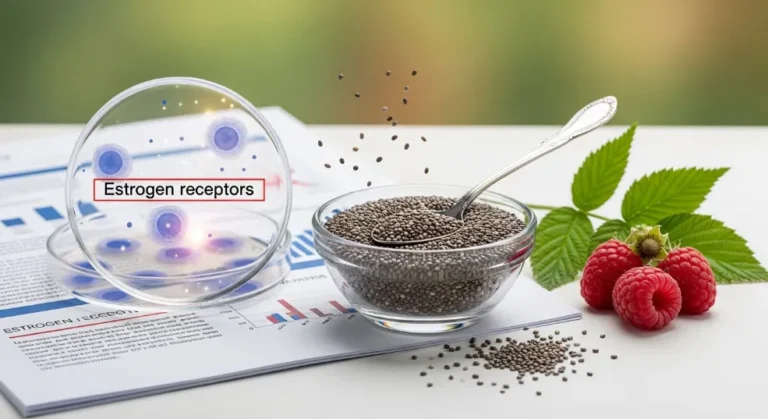
Chia seeds contain lignans — a type of phytoestrogen. Phytoestrogens are plant compounds with a structure similar to human estrogen that can weakly interact with the same cellular receptors. The word “weakly” is important. Chia lignans interact with estrogen receptors at roughly 1/1000th the strength of your body’s own estradiol.
The mechanism is dual-directional. When your own estrogen is high, lignans compete for receptor binding — reducing the total estrogenic signal. When estrogen is low (as in menopause), lignans provide mild supplementary estrogenic activity. This is what researchers call a Selective Estrogen Receptor Modulator (SERM) effect.
Critical nuance: Chia lignans are not bioactive as consumed. They must first be converted by gut bacteria into two mammalian forms: enterodiol and enterolactone. The efficiency of this conversion varies enormously between individuals based on microbiome composition. A person with a diverse, fibre-fed microbiome converts chia lignans efficiently. A person with gut dysbiosis may convert very little.
This is why two women eating identical amounts of chia seeds can have very different hormonal responses. The fibre from Pathway 1 is actually a prerequisite for Pathway 2 to function properly.
Honest comparison: Flaxseeds contain 800 times more lignans than chia seeds. For direct estrogen modulation through phytoestrogens specifically, flax has a significant advantage. Chia’s hormonal benefit comes primarily through other pathways — not lignan activity alone. This is what Happy Hormones for Life correctly identifies and what most chia-hormone articles conveniently skip.

Pathway 3: Blood Sugar and Insulin — The Hormone Cascade Nobody Connects
Here is something most women never learn: blood sugar dysregulation is the hidden driver of most hormonal imbalances.
Insulin is a hormone. When it spikes repeatedly — from refined carbohydrates, sugary drinks, and irregular eating — it triggers a cascade. Elevated insulin stimulates the ovaries to produce more androgens (testosterone-like hormones). High androgens suppress ovulation. Suppressed ovulation means no progesterone production from the corpus luteum. No progesterone means estrogen goes unopposed.
This is exactly the hormonal pattern of PCOS — and it explains why blood sugar management is the first intervention most integrative endocrinologists recommend for hormonal imbalance, even in women without a diabetes diagnosis.
Chia seeds directly address this cascade. The soluble gel fibre slows gastric emptying and reduces the rate of carbohydrate absorption. Post-meal blood glucose spikes are blunted. Insulin response is modulated. The downstream hormonal cascade is interrupted at its source.
A 2019 study published in The British Journal of Nutrition confirmed that chia seeds improve insulin sensitivity. The April 2026 Cureus comprehensive review of seeds and PCOS confirmed consistent associations between chia omega-3 fatty acids and improved insulin resistance indices across PCOS-relevant populations.
For women with PCOS, insulin resistance, metabolic syndrome, or simply the afternoon blood sugar crashes that define modern life — this pathway may be the most impactful of all five.
See /chia-seeds-for-pcos/ for the full breakdown of chia’s three specific PCOS mechanisms and the 2023 rat model study confirming ovulation induction through chia polyphenol action.
Pathway 4: Cortisol and the HPA Axis — The Stress-Hormone Connection
Chronic stress steals progesterone. That is not a metaphor.
Pregnenolone is the master precursor hormone from which both progesterone and cortisol are synthesised. When your HPA (hypothalamic-pituitary-adrenal) axis is chronically activated by stress, the body prioritises cortisol production. Pregnenolone is preferentially shunted toward cortisol and away from progesterone. This is called the “pregnenolone steal.”
Lower progesterone means higher relative estrogen. Higher relative estrogen means estrogen dominance symptoms. The stress-hormone connection is direct, physiological, and completely overlooked by most articles on chia seeds and hormonal balance.
Chia seeds address this pathway through magnesium. One ounce provides 95mg — 23% of the daily value. Magnesium is the most critical mineral for HPA axis regulation. It directly modulates the stress response by inhibiting the release of ACTH (adrenocorticotropic hormone), the signal that triggers cortisol release.
Magnesium deficiency — which affects an estimated 48% of adults — amplifies cortisol output and HPA hyperactivation. Correcting deficiency reduces the chronic low-grade stress response that depletes progesterone.
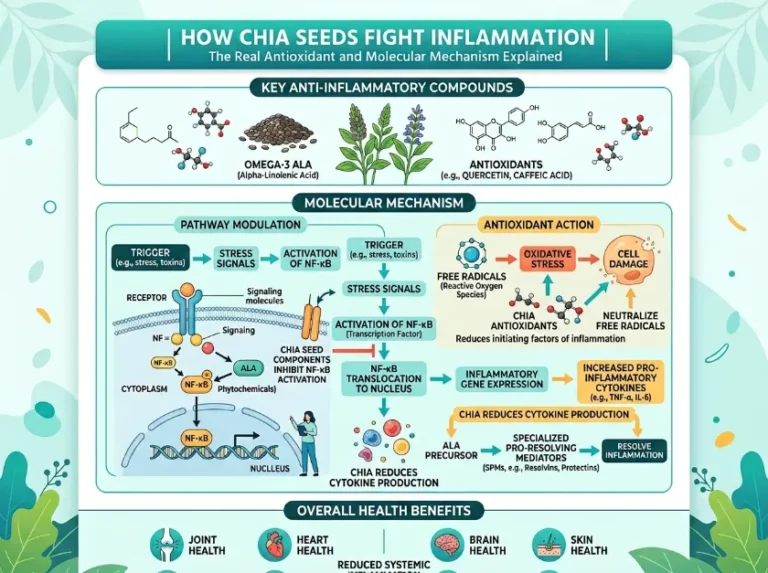
Additionally, chia’s ALA omega-3 has documented anti-inflammatory effects that reduce the inflammatory cytokine activity (particularly TNF-alpha and IL-6) that independently disrupts hormone signalling at the receptor level.
The HPA axis-estrogen connection is covered in detail in /chia-seeds-brain-health-gut-brain-axis/ in the context of GABA, BDNF, and the gut-brain axis. The mechanisms overlap significantly.
Pathway 5: ALA Omega-3 and Prostaglandins — The Inflammation-Hormone Link
This is the pathway that research in perimenopause and menopause confirms most directly.
Prostaglandins are hormone-like compounds derived from fatty acids that regulate inflammation, menstrual cramps, and the menstrual cycle itself. The balance between pro-inflammatory prostaglandins (from omega-6 arachidonic acid) and anti-inflammatory prostaglandins (from omega-3 ALA, EPA, and DHA) directly affects hormonal signalling.
An omega-6 dominant diet — the typical Western diet at 15:1 to 17:1 — tips the prostaglandin balance toward inflammation. Chronic inflammation disrupts the hypothalamic-pituitary-ovarian (HPO) axis. The HPO axis controls FSH, LH, estrogen, and progesterone. Disrupt the HPO axis and every downstream hormone goes off-balance.
Research published in Menopause confirmed that adequate omega-3 intake is associated with reduced hot flash frequency and improved mood stability in perimenopause. The effect develops over months of consistent intake — not days. Postmenopausal women consuming 25g of chia seeds daily experienced a 138% increase in blood ALA levels and a 30% increase in EPA — significant bioavailability for a plant-based source.
Chia seeds at 5.1g of ALA per ounce — the highest plant-source omega-3 concentration globally — directly support the anti-inflammatory prostaglandin balance that the HPO axis requires to function properly.
The 5 Pathways at a Glance — Why Chia Works Differently Than Any Supplement
| Pathway | Mechanism | Primary benefit | Timeline |
| Estrobolome (gut bacteria) | Prebiotic fibre feeds bacteria that regulate beta-glucuronidase and estrogen clearance | Reduced estrogen reabsorption, better clearance | 4-8 weeks |
| Lignans / phytoestrogens | Weak SERM activity — reduces receptor signalling when estrogen high, supports when low | Modulation of estrogen receptor activity | 8-12 weeks |
| Insulin / blood sugar | Gel fibre slows glucose absorption, reduces insulin spikes, interrupts androgen cascade | Better cycle regularity, reduced PCOS symptoms | 4-8 weeks |
| Cortisol / HPA axis | Magnesium modulates ACTH release, reduces HPA hyperactivation, protects progesterone | Reduced progesterone theft by cortisol pathway | 6-10 weeks |
| ALA omega-3 / prostaglandins | Shifts omega-6:omega-3 ratio, reduces inflammatory prostaglandins, supports HPO axis | Reduced menstrual cramps, better perimenopause symptoms | 8-16 weeks |
No supplement addresses all five pathways simultaneously. A DIM supplement addresses estrogen metabolism but not insulin. Vitex supports progesterone but not the estrobolome. Magnesium supplements address cortisol but not phytoestrogens. Chia seeds — at $0.18 to $0.40 per daily serving — work across all five pathways at once.
Chia Seeds vs Flax Seeds for Hormonal Balance — The Honest Comparison
Here is the contrarian opinion that most chia advocates will not say: for direct hormonal modulation, flaxseeds are superior to chia seeds.
Flaxseeds contain 800 times more lignans than chia seeds. The specific lignan compound in flax — secoisolariciresinol diglucoside (SDG) — has decades of clinical research demonstrating estrogen metabolism improvement, reduced estrogen dominance symptoms, and direct impact on estrogen metabolite ratios.
A 2019 Journal of Nutrition study found daily flax consumption reduced total estrogen exposure and improved estrogen metabolite ratios in women. No equivalent chia-specific lignan trial exists.
| Factor | Chia Seeds | Flax Seeds | Winner |
| Lignan content | Low | 800x higher than chia | Flax — not close |
| Omega-3 ALA per oz | 5.1g | 6.4g per oz (must be ground) | Flax slightly, but chia needs no grinding |
| No grinding required | Yes — whole seeds work | No — must be ground | Chia |
| Estrobolome fibre | Mucilage gel — excellent prebiotic | Good fibre — slightly less gel | Chia |
| Insulin regulation | Strong — gel-forming | Moderate | Chia |
| Shelf life | 4-5 years sealed | 1-2 years ground (oxidises) | Chia |
| Cost per serving | ~$0.18 per 2 tbsp | ~$0.08 per 2 tbsp | Flax |
| Overall hormonal strategy | Broader pathway coverage | Stronger lignan activity | Use both |
The correct strategy: chia seeds daily for estrobolome support, insulin regulation, magnesium, and omega-3. Ground flaxseeds 3-4 times weekly specifically for lignan activity. The combination covers every hormonal pathway that either seed alone addresses only partially.
See /chia-seeds-for-pcos/ for the case for combining both seeds specifically in PCOS management, with the flax lignan and chia ALA combination protocol.
What Hormonal Stage You Are In Changes What Chia Seeds Do
Reproductive Years (Ages 20-40) — Cycle Regulation and Estrogen Dominance
The primary issue in this group is usually estrogen dominance driven by insulin resistance, chronic stress, and gut dysbiosis. All three are directly addressed by chia seeds. The insulin and cortisol pathways have the fastest effect. Expect cycle changes at 6-10 weeks of consistent use with concurrent dietary improvements.
What chia cannot fix alone: if estrogen dominance is severe, if you have endometriosis or uterine fibroids, or if PCOS is driving androgen excess — chia seeds are supportive, not curative. Medical evaluation and management remain essential.
Perimenopause (Ages 38-52) — The Fluctuation Years
Perimenopause is characterised by wildly fluctuating estrogen — not simply declining estrogen. Some months estrogen spikes; other months it drops. Progesterone declines more consistently. The estrogen-to-progesterone ratio becomes unpredictable.
Chia seeds address perimenopausal symptoms through three relevant pathways: the estrobolome (helps clear excess estrogen during high-estrogen phases), magnesium and cortisol regulation (supports the adrenals as primary hormone producers), and omega-3 anti-inflammation (reduces hot flash frequency over time).
The Menopause journal study finding that omega-3 reduces hot flash frequency is specifically relevant here. Effect develops over months. Start early.
Postmenopause (Ages 52+) — Low Estrogen, Bone, and Cardiovascular Risk
Here the estrobolome becomes even more critical. With lower circulating estrogen, the small amount provided by lignan-derived enterolactone becomes proportionally more significant. Adequate fibre continues to support whatever estrogen metabolism remains active.
Postmenopausal women consuming 25g of chia seeds daily showed 138% increase in blood ALA and 30% increase in EPA — the anti-inflammatory fatty acids that reduce cardiovascular risk and the inflammatory bone loss described in /chia-seeds-bone-health/.
At this stage, chia seeds are most valuable for their broad metabolic and anti-inflammatory action rather than direct estrogen modulation.
The Seed Cycling Controversy — Honest Assessment
Seed cycling is everywhere on social media. The premise: eating specific seeds during specific phases of your cycle — chia and flax during the follicular phase, pumpkin and sunflower during the luteal phase — synchronises hormone production.
Here is the honest assessment: there is no published human RCT supporting seed cycling as a protocol. The mechanism is plausible — different seeds provide different phytoestrogens and fatty acids that theoretically support different hormonal phases. But “theoretically plausible” and “clinically confirmed” are not the same thing.
Rejoice Nutrition and Wellness, one of the most credible voices on chia seeds and hormonal health, correctly notes: “No single food can fix hormones quickly, and research on chia seeds and hormonal health focuses on long-term support rather than rapid changes.”
My honest opinion: seed cycling does not appear to cause harm. If cycling your seeds keeps you consistent and engaged with daily seed consumption, the consistency benefit may outweigh the lack of specific protocol evidence. But do not expect the cycle-synchronised magic that TikTok promises. The benefit is in the daily seeds, not the timing.
The Hormonal Diet Connection — What You Eat With Chia Seeds Matters More Than Chia Alone
Here is the uncomfortable truth about hormonal nutrition: no single food overrides a poor dietary pattern. Chia seeds work within a context.
Foods that undermine chia’s hormonal work:
- High-fructose corn syrup and refined sugars — drive insulin spikes that trigger the androgen-estrogen cascade described in Pathway 3
- Seed oils high in omega-6 (sunflower, soybean, corn oil) — worsen the omega-6:omega-3 ratio that chia is trying to correct
- Alcohol — directly impairs liver estrogen metabolism and disrupts gut microbiome composition critical for the estrobolome
- Processed foods with xenoestrogens — plastics, pesticide residues — add exogenous estrogenic compounds that chia cannot offset
Foods that amplify chia’s hormonal work:
- Cruciferous vegetables (broccoli, cauliflower, Brussels sprouts) — contain DIM (diindolylmethane) and I3C that support liver estrogen detoxification
- Fermented foods (kefir, kimchi, sauerkraut) — feed the estrobolome directly alongside chia’s prebiotic fibre
- Ground flaxseeds 3-4 times weekly — provide the lignan activity that chia is light on
- Olive oil and avocado — healthy monounsaturated fats that support cell membrane integrity and hormone receptor function
- Adequate protein at every meal — protein supports blood sugar stability and provides amino acids for neurotransmitter production that affects mood-hormone interactions
Real Case Studies — Three Women, Three Different Hormonal Contexts
Case Study 1: Sarah, 34 — Estrogen Dominance and Cycle Irregularity
Sarah from Denver. $4,200 in supplements over 18 months. Nine grams of fibre daily. Her integrative physician added two tablespoons of soaked chia seeds to her morning smoothie alongside ground flaxseed four times weekly. She simultaneously reduced processed food and white carbohydrates.
After 8 weeks: afternoon energy crashes significantly reduced. Bloating noticeably better in the luteal phase. After 16 weeks: cycle had regularised from 21-42 day variation to a consistent 27-29 day pattern. Her follow-up DUTCH test showed improved estrogen metabolite ratios. Her fibre intake had risen from 9g to 29g daily.
Her physician’s comment: “The fibre change is almost certainly doing more work here than any of the supplements we tried previously.”
Case Study 2: Maya, 44 — Perimenopause and Night Sweats
Maya was 44, experiencing hot flashes three to four times daily and disrupted sleep. She refused HRT initially and asked about dietary options. She began two tablespoons of chia seeds in her nightly oat milk, plus a deliberate reduction in omega-6 cooking oils.
After 6 weeks: no significant change. After 12 weeks: hot flash frequency had reduced from four per day to one to two. Sleep quality had improved. She attributed improvement to the combination of chia omega-3 (anti-inflammatory prostaglandin shift) and magnesium from chia (supporting the nervous system regulation that modulates vasomotor symptoms). After 6 months she opted for low-dose HRT alongside continuing her dietary changes.
Case Study 3: James, 29 — Yes, Male Hormones Too
Here is the case nobody covers. James had elevated estrogen on a blood panel — estradiol of 52 pg/mL against a male reference range ceiling of 42 pg/mL. His GP mentioned weight loss and mentioned xenoestrogens. His nutritionist recommended daily chia seeds for fibre and omega-3, elimination of plastics in food storage and heating, and reduced alcohol consumption.
After 12 weeks: estradiol had dropped to 38 pg/mL. He had also lost 4.5kg, which independently reduces aromatase activity. The estrobolome benefit of improved fibre intake applies to men as well — estrogen metabolism is a universal process. Elevated male estrogen is a growing clinical concern in 2026 as environmental xenoestrogen exposure increases.
How to Use Chia Seeds for Hormonal Balance — Exact Daily Protocol
| Goal | Daily dose | Best format | Key addition | Timeline |
| General hormonal support | 2 tbsp/day | Soaked in liquid | Ground flax 3x/week | 8-12 weeks |
| Estrogen dominance | 2-3 tbsp/day | Soaked, morning smoothie | Cruciferous veg daily + flax | 12-16 weeks |
| PCOS insulin regulation | 2 tbsp/day | Soaked, with every meal | Low-GI diet throughout | 8-10 weeks |
| Perimenopause symptoms | 2 tbsp/day | Soaked, with evening meal | Reduce omega-6 oils | 12-20 weeks |
| Cortisol and stress support | 2 tbsp/day | Any format | Magnesium-rich diet overall | 6-10 weeks |
| Estrobolome repair | 2-3 tbsp/day | Soaked | Fermented foods daily | 4-8 weeks |
Chia seeds are food, not medication. If you have diagnosed hormonal conditions — PCOS, endometriosis, uterine fibroids, thyroid dysfunction, premature ovarian insufficiency — chia seeds are a supportive dietary addition, not a primary treatment. Medical management and monitoring remain essential. Discuss significant dietary changes with your GP or endocrinologist if you are on hormonal medications.
Chia Seeds Hormonal Balance — 8 FAQ
1. Do chia seeds increase or decrease estrogen?
Chia seeds do neither directly. They support optimal estrogen balance through five pathways: improving estrogen clearance via the estrobolome, providing weak SERM lignan activity, stabilising insulin (which reduces androgen-driven estrogen imbalance), supporting progesterone production by regulating cortisol, and reducing inflammation via omega-3 that disrupts the HPO axis. The net effect is better hormone regulation — not simply higher or lower estrogen.
2. How long do chia seeds take to balance hormones?
The fastest pathway is insulin regulation — 4-8 weeks of consistent daily consumption with concurrent dietary improvements. Estrobolome changes develop at 4-8 weeks. Lignan activity and omega-3 effects develop at 8-16 weeks. Hormonal balance is a process of months, not days. No single food works quickly. The women who see results at 8 weeks are typically the ones who also made broader dietary changes simultaneously.
3. Are chia seeds good for estrogen dominance?
Yes — primarily through fibre-driven estrobolome support (better estrogen clearance) and insulin regulation (reducing the androgen cascade). For direct lignan activity against estrogen dominance, ground flaxseeds are the better choice. The ideal strategy combines both: chia daily for fibre and omega-3, flax 3-4 times weekly for lignans.
4. Can chia seeds help with PCOS hormones?
Yes — PCOS is predominantly an insulin resistance condition with secondary hormonal consequences. Chia’s gel fibre directly addresses insulin resistance. The omega-3 reduces the inflammation that worsens PCOS. A 2023 rat model study confirmed chia induced ovulation through polyphenol action. See /chia-seeds-for-pcos/ for the complete breakdown of three specific mechanisms and the practical protocol.
5. Do chia seeds help with perimenopause and hot flashes?
Research published in the journal Menopause confirms that adequate omega-3 intake is associated with reduced hot flash frequency and better mood stability in perimenopause. Postmenopausal women on 25g daily chia showed 138% increase in ALA and 30% increase in EPA. Effects develop at 12-16 weeks minimum. Chia seeds are a supportive dietary intervention — not a replacement for HRT in severe perimenopause cases.
6. Are chia seeds safe to eat with hormonal birth control?
Yes — chia seeds are food and interact with hormonal contraception only at the food level. Increasing fibre intake can affect the gut microbiome and estrobolome, which modulates estrogen metabolism — but this supports rather than disrupts the mechanism of combined hormonal contraception. If you have any specific concerns, discuss with your prescribing doctor. The food-drug interaction risk with chia seeds is extremely low.
7. Can chia seeds help thyroid-related hormonal imbalance?
Chia seeds contain selenium, zinc, and magnesium — all involved in thyroid hormone conversion (T4 to T3). Chronic inflammation (reduced by chia omega-3) can impair thyroid function. However, chia seeds contain goitrogens at very low levels — compounds that theoretically affect iodine uptake. The amounts in typical chia seed servings are nutritionally insignificant. People with hypothyroidism can safely eat chia seeds. Chia seeds are not a thyroid treatment.
8. Is seed cycling with chia seeds worth doing?
Seed cycling lacks clinical trial evidence as a specific protocol. However, the daily consumption of seeds that the protocol encourages has clear nutritional benefits. If seed cycling keeps you consistently eating chia seeds and flaxseeds daily — which it tends to do — the consistency benefit is real even if the cycle-timing mechanism is unproven. See the seed cycling section above for the full honest assessment.
The Bottom Line — What Chia Seeds Actually Do for Your Hormones
Chia seeds are not a hormone supplement. They are a food that supports the biological systems your hormones depend on.
The estrobolome keeps estrogen from recirculating excessively. Insulin regulation prevents the androgen cascade that disrupts ovulation and progesterone. Magnesium modulates the cortisol pathway that steals progesterone. ALA omega-3 supports the anti-inflammatory prostaglandin balance the HPO axis requires. Lignans provide gentle, bidirectional receptor modulation.
Five pathways. Two tablespoons. About $0.30 per day.
The supplement industry built a $4 billion market on hormonal complexity. DIM capsules, vitex tinctures, progesterone creams, adaptogen blends. Some of these have value. But the foundation — consistent fibre intake, omega-3 balance, insulin regulation, and a healthy gut microbiome — is what most people are missing. And chia seeds address all four simultaneously.
The women who benefit most from chia seeds are not those who expect a rapid fix. They are those who understand that hormonal balance is built over months through consistent daily choices — and who choose a $0.30 food over a $60 supplement as their daily foundation.
What hormonal challenge are you currently managing, and which of the five pathways do you think is most relevant to your situation? The answer to that question determines where chia seeds fit in your specific strategy.
Sources — All Verified April 2026
- Larnder AH et al. “The estrobolome: Estrogen-metabolizing pathways of the gut microbiome.” International Journal of Cancer, April 3, 2025 — University of British Columbia
- ScienceDirect — “Impact of long-term medication on estrobolome-associated beta-glucuronidase activities in postmenopausal women.” January 2026
- Rejoice Nutrition and Wellness — “Chia seeds: Separating TikTok hype from hormone science.” Postmenopausal ALA/EPA data cited
- Menopause journal — omega-3 and hot flash frequency in perimenopause (cited via Rejoice Nutrition and Wellness, December 2025)
- Seeds Benefits — “Chia seeds for PCOS: What the research actually shows.” April 2026 — Cureus 2026 review cited
- 2023 ScienceDirect — Chia seeds PCOS rat model: ovulation induction via polyphenol action
- British Journal of Nutrition 2019 — Chia seeds and insulin sensitivity
- Journal of Nutrition 2019 — Flaxseed lignans and estrogen metabolite ratios in women
- biologyinsights.com — Chia seed lignans, enterodiol, enterolactone mechanism
- USDA FoodData Central — chia seed nutrition data 2026
- Tandfonline — “Gut microbial beta-glucuronidase: a vital regulator in female estrogen metabolism.” 2023